
From São Paulo to Belém: What PRI in Person and COP30 Mean for CFOs
The back-to-back convenings of PRI in Person (PiP) in São Paulo and COP30 in Belém delivered a simple but demanding message: credible, science-aligned transition and resilience plans must now be investable at scale—especially in emerging markets—if we are to keep 1.5°C within reach.
Held ten years after the Paris Agreement—and in the Amazon region for the first time—COP30 underscored both the urgency and the unprecedented opportunity for the private sector to lead on climate action, resilience and sustainable development. PiP similarly stressed a whole-of-government approach, nationally grounded transition and investment plans and clearer economic policies that operationalize the Global Stocktake, carbon markets and deforestation measures. Insights from PiP reinforced the growing convergence between investors, CFOs, policymakers and businesses around concrete pathways for capital mobilisation, transition planning and enabling policy environments.
But as we translate Belém’s signals for corporate finance, we should be clear-eyed about the political context: the final COP30 decision text landed with glaring omissions. There is no explicit reference to phasing out or transitioning away from fossil fuels and the anticipated language on ending deforestation—a core expectation for an Amazon-hosted COP—did not materialise. These gaps underscore the fragility of multilateral consensus and the slower-than-needed alignment on key levers for decarbonisation and nature protection.
For CFOs, this is not a signal to step back but to plan with realism. It reinforces the need for strong institutions, robust internal governance, and transition and resilience strategies that can hold under uncertainty. Regulation will remain uneven, but companies must be ready for whatever comes—designing plans that withstand shifting policies while continuing to mobilise capital and deliver measurable progress.
Despite continued uncertainty around regulatory action, the reality is clear: the next decade of climate action will be defined not by commitments, but by credible, investable and science-aligned implementation.
Despite its shortcomings, this COP brought nature and adaptation to the fore in a way that it has not been in the past, highlighting a continued integration of biodiversity into climate action and a sharper focus on closing the adaptation finance gap, particularly in emerging markets and climate-vulnerable economies. As climate-driven vulnerabilities across value and supply chains mount, this focus is critical for CFOs planning for long-term resilience. Notably, COP30 also saw a continued increase in private sector representation at the annual Conference. Fortune 100 companies sent more representatives than last year, when their numbers hit an all-time high, despite the lack of a government delegation from the United States.
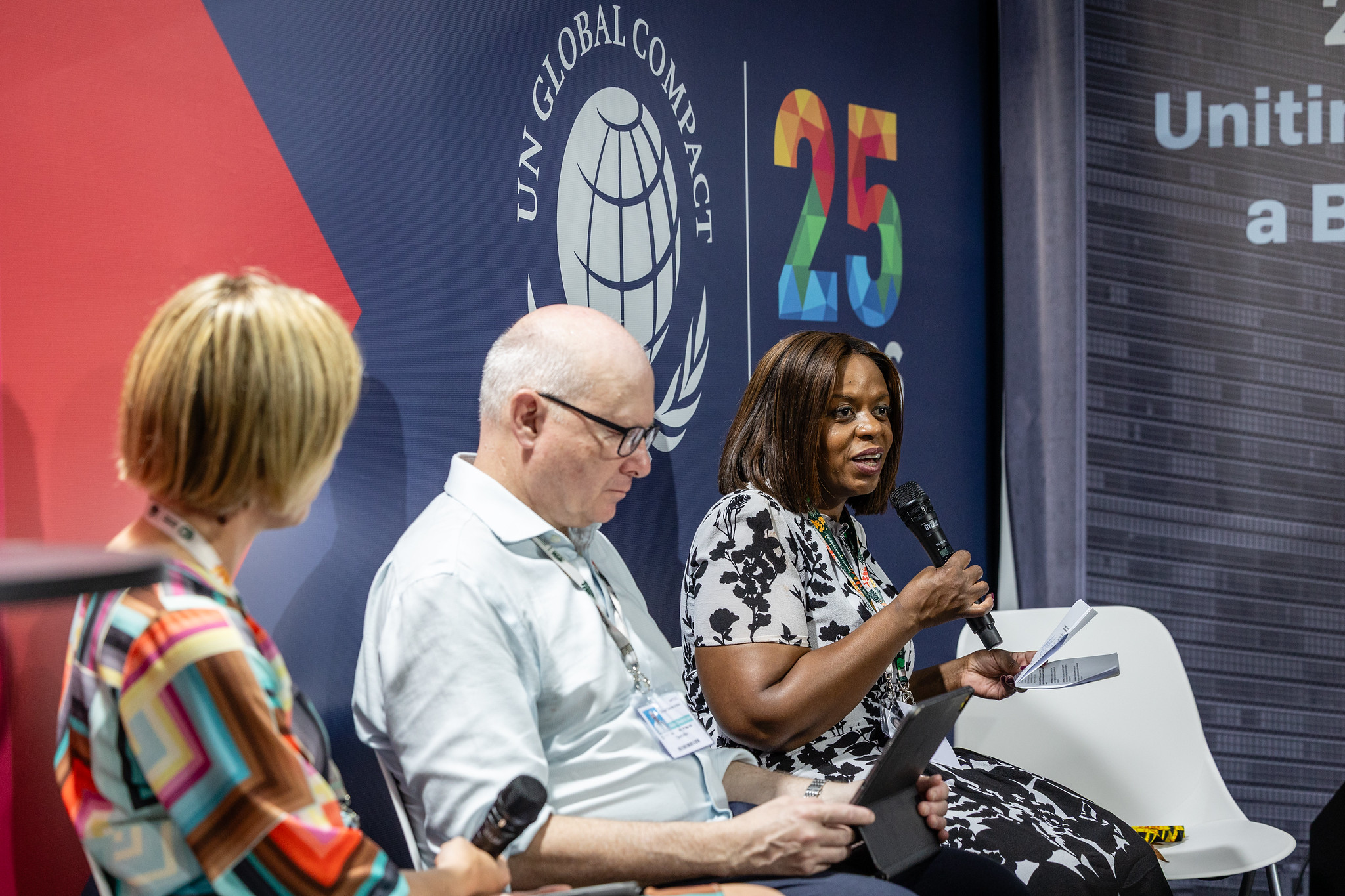
The UN Global Compact’s presence in Belém, including hosting the 13th Annual High-Level Meeting of Caring for Climate, amplified the central message: mobilizing finance at scale, particularly toward emerging markets and developing economies (EMDEs), is now the linchpin for achieving a 1.5°C-aligned and resilient global economy.
Here are five key takeaways CFOs should carry forward from COP30 into the wider sustainable finance agenda:
1. A New Era of Investable and Science-Aligned National Plans
A first takeaway from Belém is that the new generation of Nationally Determined Contributions (NDCs) must be science-aligned and investable. Participants at the Caring for Climate High-Level Meeting agreed that newly submitted NDCs cannot function as a ceiling; they must be the floor of ambition, designed to transform energy systems and align entire economies with a 1.5°C pathway. Businesses were encouraged to respond with credible net-zero transition plans, science-based targets, rapid emissions reductions across value chains and clear strategies for shifting finance away from fossil fuels and toward renewables.
In practice, CFOs should view COP30 as a strong market and investor signal, rather than a guarantee of near-term policy convergence. The final agreement’s omissions - especially the lack of explicit language on fossil fuels - underline how far governments are from a clean and coordinated pathway. And with the United States not sending an official delegation at all, any shift in policy direction is unlikely to be mirrored in the single largest capital market in the near term, reinforcing a fragmented regulatory environment.
For CFOs, this means two things: don’t wait for perfect policy clarity and don’t assume it will arrive evenly. Instead, treat COP30 as confirmation that the direction of travel is set—even if the politics are messy—and build transition and adaptation strategies that are robust under multiple policy scenarios. That includes using tools like internal carbon pricing, scenario-based capital planning, and jurisdiction-specific compliance roadmaps so you can keep moving investment into low-carbon and resilient assets now, while minimising downside risk if regulation tightens faster in some markets than others.
2. Capital Mobilisation to EMDEs Is Now a Global Imperative—And Brazil Is Leading the Way
COP30 made plain that mobilizing capital to EMDEs has moved from a recurring theme to a hard requirement. PRI in Person highlighted Brazil’s ambition to lead on this agenda, most notably through the Tropical Forests Forever Facility, a Blended Finance scheme that aims to crowd in four dollars of private investment for every one dollar of public finance.
The model became a reference point in Belém for what viable blended finance can look like at scale—investable, return-oriented, and tied to nature-positive outcomes. The “Baku to Belém Roadmap” toward a $1.3 trillion finance goal continued to gather momentum as the core pathway for getting the volumes right, provided policy barriers are removed and risk-sharing structures deepen.
For global CFOs - and especially those within the UN Global Compact CFO Coalition - the implication is not only that the opportunity set in EMDEs is widening, but that scaling investment will hinge on stronger standardisation of KPIs and evidence-backed models, like the case studies soon to be shared in the upcoming Blended Finance Playbook, that make risk, impact and returns transparent and comparable across markets.
3. The Private Sector Is Ready—But Needs Regulatory Alignment
The private sector has already demonstrated a readiness to move faster on climate goals even as the policy landscape remains uneven, and in some areas, unresolved. The UN Global Compact CEO Study shows that 88% of CEOs see a stronger business case for sustainability than five years ago and 99% plan to maintain or expand their climate, environmental and social commitments.
In Belém, this optimism was paired with a blunt reality check: capital will not flow at the speed required unless governments deliver clearer regulations, predictable incentives and practical partnership frameworks that de-risk sustainable investment. This is the same thesis PRI advanced in São Paulo, where strengthening understanding between investors and policymakers was framed as essential to building an enabling environment for responsible investment.
For CFOs, the message is to keep advancing investable transition and resilience plans now, while managing policy risk through flexibility with clear internal guardrails that align spend with the direction of travel of regulation, even where timelines and wording still vary across markets.
4. Nature, Adaptation and Resilience Are No Longer Secondary Priorities
Nature, adaptation and resilience emerged as equal priorities to mitigation in the finance narrative. The UN Global Compact came to COP30, emphasizing that investing in resilience must go hand in hand with emissions reduction and that adaptation is now core to protecting people, assets, supply chains and competitiveness. A recurring message in Belém was that the adaptation finance gap is widening, especially in emerging markets and climate-vulnerable economies where climate impacts are already eroding growth and stability, and that significantly larger, better-structured flows of capital are needed to close it.
PRI’s climate priorities heading into and beyond COP30 echo this by calling for much larger adaptation finance flows, deeper integration of climate and nature strategies and just transition approaches that preserve social cohesion and livelihoods. Together, these signals point to adaptation finance as a mainstream capital allocation question, not a niche development issue.
The practical CFO takeaway is that resilience investing is becoming financially material, disclosures around physical risk and adaptation readiness will keep tightening and capital planning needs to reflect the real cost of climate volatility.
5. Collaboration Across the Investment Ecosystem Is Accelerating
Despite continued uncertainty in country-level negotiations, COP30 and PiP underscored how collaboration across the investment ecosystem is maturing.
Across the two events, the UN Global Compact engaged in joint convenings with PRI, UNEP FI and leading asset owners on sustainable investment, blended finance, transition planning and credibility in net-zero policy. These discussions explored how coordinated acceleration — aligned corporate policies, scaled investment, and rapid workforce transformation — can drive global progress at the speed required. Fragmented adoption, with companies advancing unevenly and prioritizing short-term interests, will only further entrench instability and inequality.
COP30 and the Road Ahead: A Decisive Decade but Not Yet a Decisive Breakthrough
Taken together, COP30’s signals sit within a decisive decade—not because this COP unlocked a breakthrough, but precisely because it did not, and the window for action is narrowing. Deep divides between major emitters and the most climate-vulnerable countries were evident in Belém, reinforcing an uneven, fragmented policy landscape. For CFOs, this reality reinforces a dual imperative: global policy may not align quickly, but market expectations, transition risks, and investor scrutiny will continue to intensify.
Against this backdrop, CFOs have three overlapping priorities coming out of Belém: the first is to translate ambition into credible transition plans that sit inside financial strategy rather than alongside it—plans that can withstand policy uncertainty and still deliver measurable decarbonisation. The second is to mobilise capital toward EMDEs with integrity and speed, using blended finance models and investable country platforms that reduce risk where public policy remains inconsistent. The third is to put resilience at the heart of decision-making, recognising that adaptation, nature, and physical-risk preparedness are now fundamental to fiduciary duty and long-run value creation, regardless of political divergence.
Belém was not a moment of sweeping consensus; it was a reminder of the work still to be done. Yet it continued to push forward the reality that even without full political alignment, the direction of travel for markets, risk management, disclosure and corporate accountability continues to sharpen. Sustainability performance and financial performance are no longer separable, and capital deployment in the coming decade will determine whether global climate and sustainability goals remain within reach.
The UN Global Compact CFO Coalition’s call after COP30 and PiP is therefore pragmatic and clear: lead the shift from commitment to measurable impact, build transition and resilience strategies that hold under policy uncertainty, and treat the 1.5°C pathway and adaptation agenda as defining parameters of modern corporate finance.

